Vevang AISites/ Concrete contractors · SEO

Local SEO · Concrete contractors

Local SEO that keeps your pour schedule full

Your next driveway or patio job starts with a search and two or three estimates. We build the site and the search work that get you on that short list.

Pick a 15-minute time. Your demo is built before the call.

  • Your demo, built before the call
  • Improved every week
A sample concrete contractors website, the kind Vevang builds and keeps improving.
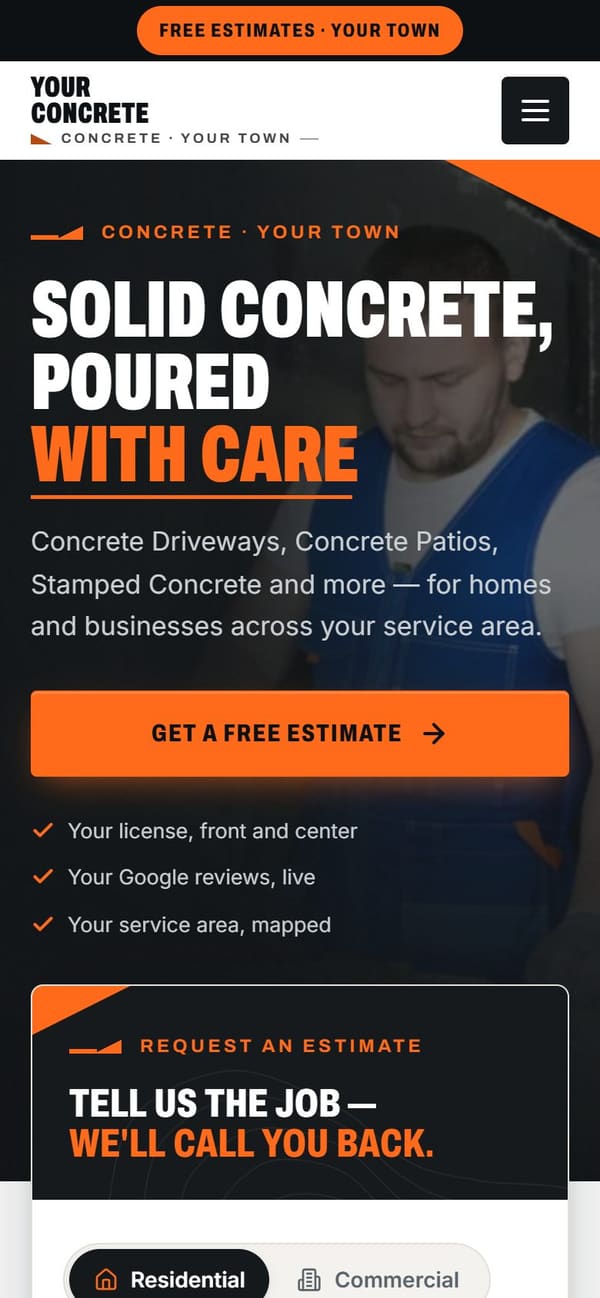
The same sample site on a phone.
Sample demo · the kind of site we build for concrete contractors

What does this include?

Vevang Sites builds your concrete website and runs the local SEO behind it: a page for each pour you take, service-area pages for the towns your trucks reach, a gallery search engines can read, and weekly improvements from our SEO Ranker agent. We track calls and forms so you see which pages book estimates.

Why it matters

Why it’s different for your trade.

01

Every pour is a different search

Someone pricing a stamped patio and someone sizing a pole barn slab type nothing alike. A single services page tries to answer both and ranks for neither. Separate pages let each job type match the words that job's buyer actually uses.

02

You are one of three bids

Homeowners line up estimates before anyone shows up. Search decides who gets called. Pages that explain base prep, reinforcement and joint layout put your reasoning in their head before the other two contractors arrive with a number.

03

Your radius is set by the truck

Concrete travels only so far before it stops being practical. Service-area pages built around the towns you genuinely pour in beat a long list of city names you would never send a crew to.

What we do

The work, step by step.

01

Split the work into real pages

Driveways, patios and pool decks, stamped and colored finishes, walkways, garage and shop slabs, footings, repair and leveling, commercial flatwork. Each gets its own page and its own language. A single Concrete Services page competes for nothing in particular.

02

Write each page like the estimate talk

Cover subgrade and compaction, reinforcement, control joint spacing, slab thickness, mix, cure time, tear-out and haul-away, and your warranty. The homeowner reads it, then starts asking your questions of the other bidders. That is how a cheaper number loses.

03

Make the gallery readable to search

Search cannot see a broom finish. Caption every photo with the finish, pattern, color, job type and town. Resize files so the page loads on a phone in a driveway, and link each finish back to the service page it belongs to.

04

Build service-area pages you can back up

Pick the towns you pour in regularly. Give each one real detail: the age of the subdivisions, the driveway failures common there, apron and sidewalk permit rules, whether access is tight for a truck. Skip the towns you would turn down.

05

Clean up structure and internal links

Fix slow galleries, broken links, duplicate headings and pages buried three clicks deep. Then link repair to replacement, stamped to patios, slabs to footings, so someone who came about one crack sees everything else you pour.

06

Improve it every week and watch the calls

SEO Ranker reviews the site weekly, tightens thin pages and adds content where searches are showing up. Call and form tracking tells you which job type each lead came from, so off-season writing targets next spring's backlog.

Common mistakes

What usually goes wrong.

One page that says everything

Driveways, patios, stamped, slabs and repair crammed under a single heading. Nobody searching for concrete leveling finds it, and the page reads like a business card. Split it and each job type gets a shot at its own results.

A photo dump with no words

Beautiful pours uploaded straight from a phone, huge files, no captions, no towns. The gallery loads slowly and tells search nothing. Naming the pattern, the color and the city turns the same photos into pages that rank.

Ignoring repair and leveling searches

You would rather pour new flatwork, so you skip the cracked slab content. Those searchers are the ones whose driveway is past saving. Answer the repair question honestly and a share of them become tear-out and replacement jobs.

Going quiet from November to March

The site sits untouched all winter, then you want spring calls in April. Rankings build slowly. Off-season is when you add pages, caption last year's jobs and set up early booking for the first warm week.

Checklist

What you can check today.

  • Give driveways, patios, stamped, slabs and repair separate pages
  • Caption every gallery photo with finish, pattern, color and town
  • Resize photos so galleries load fast on a phone
  • Write an honest repair-or-replace page about cracking and heaving
  • Keep service-area pages to towns your trucks actually reach
  • Add an estimate form that takes photos and rough dimensions
  • Post curing and de-icing salt care guidance on the site
  • Publish early-booking content before the spring rush starts

How it works

You see it first. Then you decide.

You don’t sign anything to see it. Book a time, and your demo is ready before we talk.

  1. 01

    Book 15 minutes

    Pick a time — often the same day. Tell us your website, or just your business name and city.

  2. 02

    We build your demo

    Before the call, we build a demo of your new website from your real business: your services, your area, your reviews.

  3. 03

    See it, then decide

    We walk you through the demo on the call. You see exactly what you’d get before you spend anything.

  4. 04

    Launch, then improve weekly

    We build it for real and put it live. After launch, the SEO Ranker agent keeps improving it every week.

15 minutes on Google Meet. No obligation.

Questions

Straight answers.

How long before SEO brings in estimate calls?

Months, not weeks. New service pages get indexed first, then gain ground as they collect traffic and links. No one can guarantee a position on Google, and anyone promising one is guessing. The practical move is starting in the off-season so your driveway and patio pages are established before the first warm stretch.

Do I really need a separate stamped concrete page?

Yes. Decorative buyers search with a picture in their head and type pattern and color words: ashlar slate, wood plank, running bond, border and band. A general patio page never uses those words. A stamped page with captioned examples of each pattern matches how those searches are typed.

Should I publish repair content if I prefer new pours?

Yes. The cracked driveway search is one of the most common in your trade, and many of those slabs cannot be saved. A page explaining which cracks are cosmetic, when leveling works and when tear-out is the honest answer earns trust and often turns into a full replacement.

How many service-area pages should I have?

Only as many as you can write with real local detail. A thin page per town, copied and swapped, adds nothing. Pick the towns inside a practical drive for a ready-mix truck, write about the concrete conditions there, and keep the rest as a simple list.

What should my estimate form ask for?

Photos of the existing concrete, rough length and width, whether old slab needs removal, truck access and gate width, the finish they have in mind, and their timing. That detail lets you sort a real patio job from a curiosity before you spend an evening driving.

Does any of this help when people ask AI assistants?

Clear pages help. Assistants pull from sites that state things plainly: what you pour, where you pour it, cure times, repair options, how to reach you. We structure your site that way. Nobody can promise an AI tool will mention your business, and we will not claim otherwise.

Do reviews affect how I rank in Maps?

They are part of how local results are judged, along with your profile details and photos. We send review requests after the pour, to every customer, and reply to what comes in. We never filter who gets asked, offer anything in exchange, or touch the wording of a review.

What happens on the call?

We build a demo of your concrete site before we talk, using your work and your service area, so you are reacting to something real instead of a pitch. Fifteen minutes. You tell us which job types you want more of and we show how the pages would be laid out.


More for concrete contractors

One team for the whole job.

Reviewed 2026-09-24

Your demo is free

See your new website on the call.

Tell us your website — or your business name and city — and pick a time. We’ll have your demo ready before we talk.

Pick a 15-minute time. Your demo is built before the call.